Castor Canadensis and Castor Fiber
Whenever I am researching for a nature presentation, I come across great resources that beg to be shared.


This is from The History of Four-footed Beasts, Serpents, and Insects, 1658, which was mostly a translation of an earlier book from the 1500s. I love this book so much — it has 1100 pages of illustrations of mythical creatures as well as actual animals, along with received wisdom from Aristotle, Pliny, and Herodotus among others. Apparently every animal was a full warehouse of remedies for any human illness. I think by the time someone had mixed up the “remedy”, you would be either dead or cured already. “Oh, Honey, you have a bloody nose? I’d like to help you but we only have dried onions and liquid pitch, there are no beaver skins available to burn.”
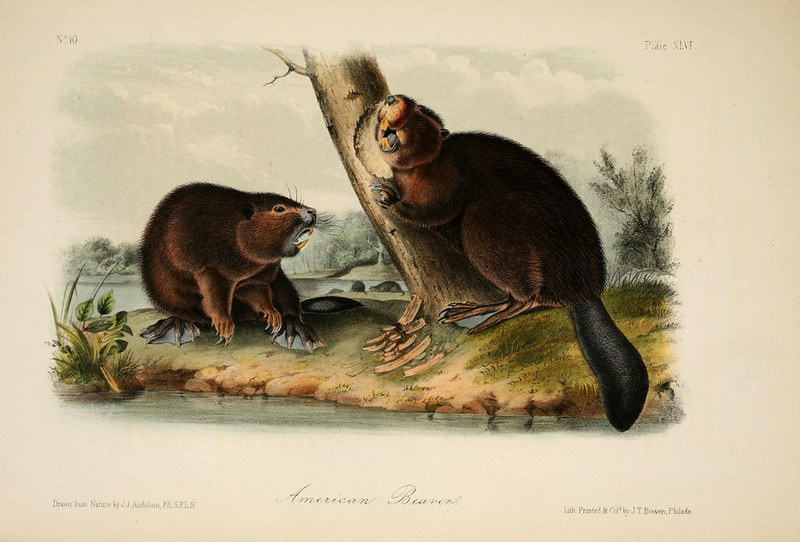
Audubon’s illustration of American Beaver, 1851
And this is from the 1857 Reports of Explorations and Surveys, to ascertain the most practicable and economical route for a railroad from the Mississippi River to the Pacific Ocean.
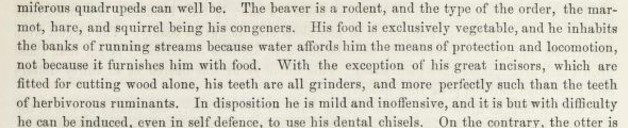
Description of beaver from an 1850s government report.
The beaver is a rodent, and the type of the order, the marmot, hare, and squirrel being his congeners. His food is exclusively vegetable, and he inhabits the banks of running streams because water affords him the means of protection and locomotion, not because it furnishes him with food. With the exception of his great incisors, which are fitted for cutting wood alone, his teeth are all grinders, and more perfectly such than the teeth of herbivorous ruminants. In disposition he is mild and inoffensive, and it is but with difficulty he can be induced, even in self defence, to use his dental chisels.
[source]
At the present time the fur of the otter is much more in demand than that of the beaver. When I was at Vancouver the prices paid in goods to the hunters by the Hudson Bay Company were for beaver skins 50 cents, for otter $2 50 each.
The beaver once inhabited all portions of the globe lying in the northern temperate zone ; yet from England, continental Europe, China, and all the eastern portion of the United States, it has been entirely exterminated, and a war so universal and relentless has been waged upon this defenceless animal, his great intelligence has been so generally opposed by the intelligence of man, that it has seemed certain, unless some kind Providence should interpose, that the Castor, like his gigantic congener, the Castoroides, would soon be found only in a fossil state. Happily, that Providence did interpose, through a certain ingenious somebody who first suggested the use of silk in place of fur, for the covering of hats. The beaver were not yet exterminated from western America ; and now since they are not “worth the killing” in those inhospitable regions where there is no encouragement for American enterprise or cupidity, we may hope that they will always there retain existence in a home exclusively their own.
“Dental chisels” has got to be one of my favorite phrases ever.
So before I read these passages, I did not know beaver had ever been in more areas than North America, and I didn’t know that a change in fashion is what saved them. I did know from Gary Paulsen’s Winterdance: the Fine Madness of Running the Iditarod, that beavers are not always “mild and inoffensive”; they can defend themselves even against wolves.
That second source I quoted from, the 1850s Reports of Explorations and Surveys etc. etc. — originated in 1854, when four surveying parties were sent out to find the best railroad route to the Pacific, starting from various points in the middle of the US. They only had 10 months to survey, which wasn’t enough time to figure out precise engineering data. They did send back enough reports on plants, birds, fishes, and Native American ways of life to fill 13 huge volumes. These are filled with beautiful plates, and the eloquent 19th-century writing that I love.
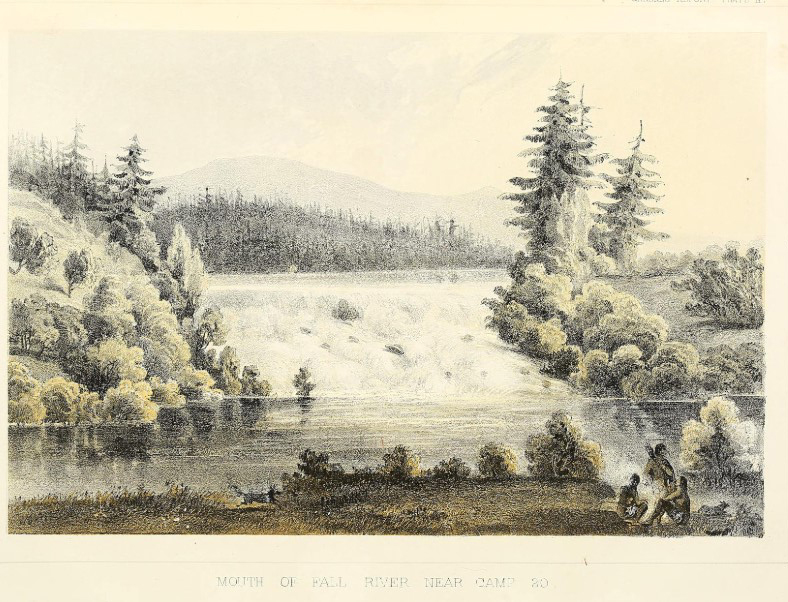
Landscape from Vol. 6 of the Pacific Railroad reports.
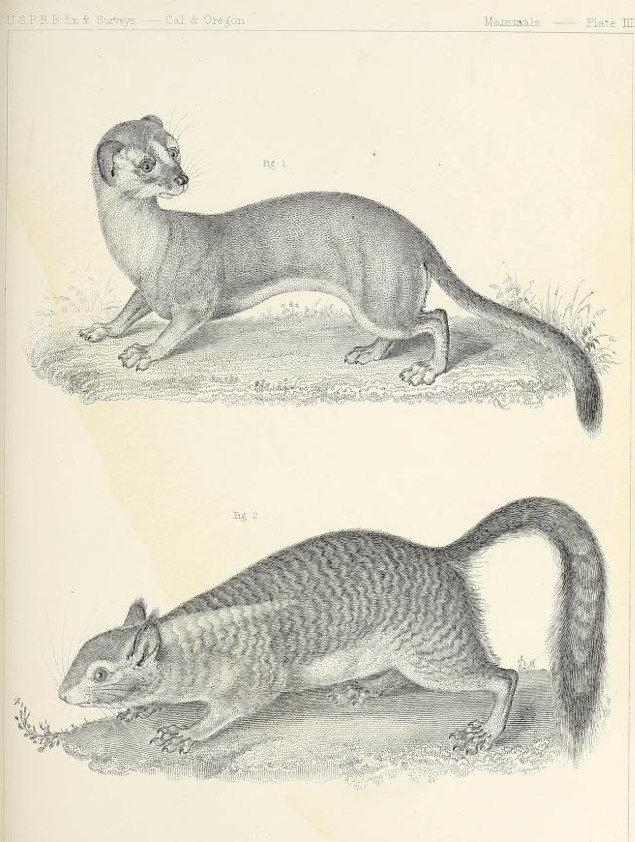
Illustrations of mammals from Vol. 6 of the Pacific Railroad reports.
Though they mentioned the beaver kindly in more than one volume, they did not include an illustration of one, except for a skull, so I borrowed the Audubon illustration above.
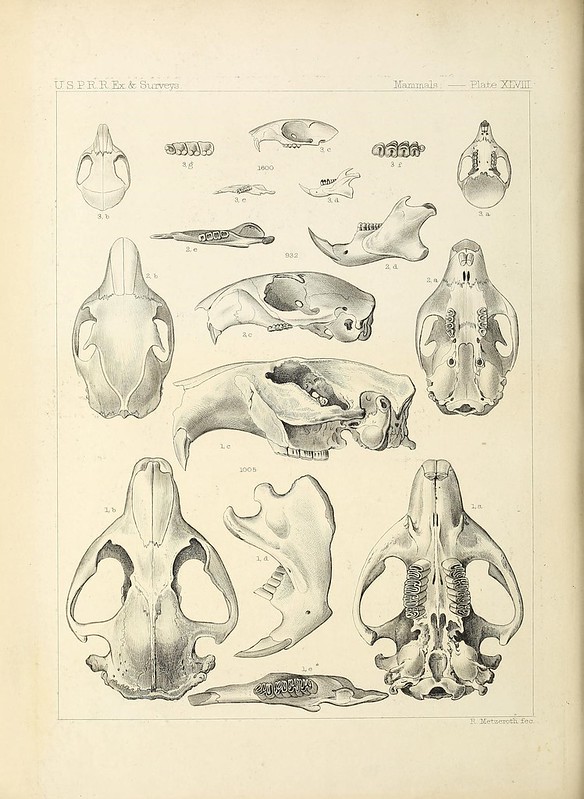
Illustration of mammal skulls, including a beaver, at bottom.
I enjoyed the description of this mammal so much that I tried to find out more about the author. It is attributed to Dr. John Strong Newberry, who was assigned as both geologist and botanist. There had been a zoologist assigned, Dr. E. Sterling, but he left the expedition due to ill health, and Dr. Newberry had taken over the zoologist duties as well. His writing is expressive and opinionated; it seems to me like he was writing just to please himself, not sure if anyone official would ever actually read it.
Besides doing research, I have also been keeping a poetry journal this year. I am working through the book Every Day Poetry: The 365 Day Poetry Project by Dustin Howard. It is a great way to finish the day, coming up with a short poem that fits a certain poetry format. So here is my ottava rima to commemorate the beaver:
Consider the gently swimming beaver
And the many services he renders —
In home building, he’s a fine achiever.
From his fallen trees, new shoots grow tender.
His glossy fur caused a fashion fever,
until silk enthralled the headware vendors.
Threatened, he’d not use his dental chisels.
Thank God the fur trade finally fizzled.



Old books like these are so important for understanding how our wildlife, and our attitudes to it, have changed over the centuries. Thank you for sharing.
You are right; I had never thought about how different attitudes were. That 1658 book seems to view every animal as just being here to be used up completely; by 200 years later at least some people were thinking about respecting the animals for what they were, whether or not they were of “service” to humans.
Some fierce looking Beavers in old texts
Yes, there are other amazing beasts in that book too, including the Manticore which has a lion-like body with a human head and a spiky tail! 🙂
😲
I loved this post, and I learned a few new things. Your poem is perfect. I smiled at the ending – you worked the dental chisels in. 🙂
This was a memory trigger for me. We homeschooled (as you know) and did an entire unit on beavers. We were fascinated by them. Jim Kjelgaard wrote children’s fiction, mostly about dogs and animals. He wrote a book titled Chip, the Dam Builder. The story was told from Chip’s point of view. I remember it being a favorite of ours.
And I love those old nature books. We always had our noses in Anna Botsford Comstock’s 1911 book – Handbook of Nature Study.
I don’t have time to add anything more to my plate. I envy you your research and nature presentations!
I will have to read books by Jim Kjelgaard! When I was reading with my kids, we were still reading all physical books so we read what we came across (all the Gary Paulsen books) but now it is so easy to find an ebook and try a new author.
I have two copies of Comstock’s nature book! I am so in awe of her abilities to observe and grasp the meaning of what she observes, and to make it plain to others.
I am glad you liked the poem. I am spending just a few minutes a night on each one and enjoying what pops out. 🙂
Very nice illustrations.