Some Herps of the Gulf Coast and South Texas
I am sharing some of my herp sightings in various Texas eco-regions.
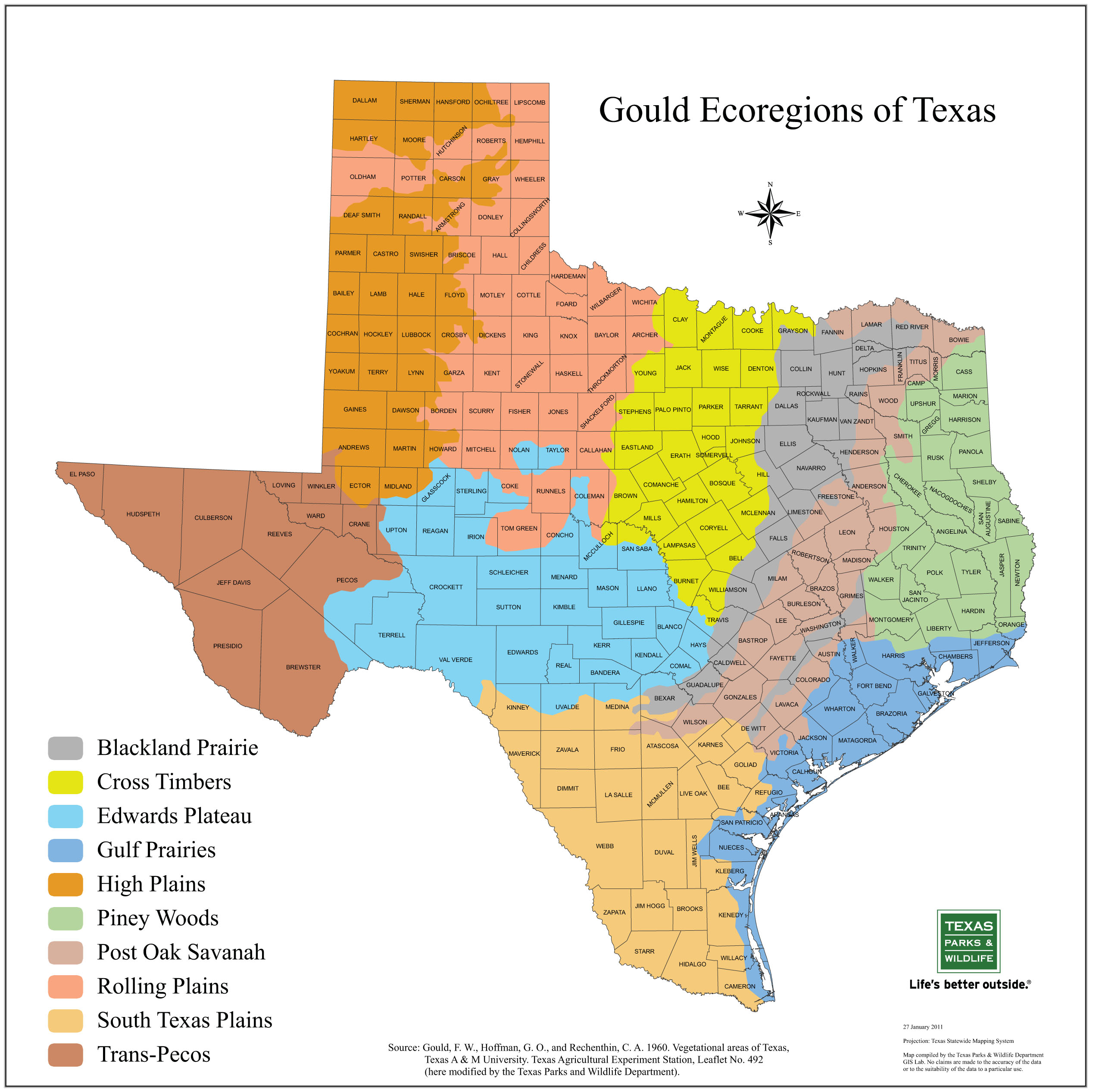
Gould Ecoregions of Texas
We are going to start with the darker blue section of the map, the Gulf Prairies. My husband is actually a native of this region, and this is where I had my first ever encounter with a wild snake, just a few days after we got married!
It was July of 1979. We lived in an apartment in southwest Houston, but a tropical depression stalled out over the southeast Houston area. Our area was completely dry but his parents’ home was flooded with 5 feet of water. Fortunately it was a 2-story house so they were safe, but a day later it was still an ordeal to get there. We drove as close as we could get, and then waded in, in thigh-deep water. (And this is where I learned that fire ants will make a giant ball of ants and rotate around, to survive in a flood, and then they will happily climb up your legs when they find you, and take a good bite to secure their hold.)
The next day the water had receded, and the clean-up began. As I was carrying a load of trash outside, I almost stepped on a copperhead coiled on their front step. I had never seen a snake in the wild before and I was so scared I could hardly tell anyone what I had seen!
Over the years, I got much braver about snakes, because I had kids who loved all animals. At zoo visits, volunteers would be outside with large snakes, offering opportunities to pet them, and it seemed ridiculous to be afraid of something when a 3-year-old was fascinated. 🙂
In all, we lived in the Gulf Coast region for 30 years, and at home, our wildlife interactions were pretty tame. Our backyard was always full of Gulf Coast toads, green anoles, and Mediterranean geckos. We used to keep the laundry room light on at night, so our two cats could sit by the window and watch “gecko TV”.


On outings and weekend trips, it was easy to find rarer wildlife.
A super-reliable site if you want to see American alligators is Brazos Bend State Park, which also has many bird species. Another fabulous site for both birds and reptiles is the Houston Audubon Smith Oaks Rookery on High Island. I have been there a few times to see the egrets, spoonbills, and cormorants nesting, but it is also a reliable place to spot American alligators, and huge spiny softshell turtles. You can click on these pictures to see larger versions.


Another amazing site is down along the coast, on Mustang Island. The Port Aransas south jetty*, is where green sea turtles are easy to spot (but not to photograph!) as they come up to the rocks to eat sea grasses. I’m sure there is more spectacular scenery in the world, but I have so many happy memories of walking along the jetty in the breeze, and watching the birds, fishermen, and turtles.
If you do go to Port Aransas, you might want to visit Amos Rehabilitation Keep which is a turtle rehab center. I haven’t been there yet, but I have been to the one further south down the coast on South Padre Island — Sea Turtle, Inc., where you can see Atlantic green sea turtles, Kemp’s Ridley, hawksbill, and loggerheads being cared for. Some will be released, but others have been injured too badly to survive in the wild, so they are permanent residents that help to educate people. Nearby is the South Padre Island Birding, Nature Center, and Alligator Sanctuary, where you can walk on long boardwalks over the shoreline, and see groups of alligators.


Moving on to the South Texas Plains region (tan in the map above), I have not gotten to spend much time there, but I did get one sought-after sighting. In March of 2020, just as word of Covid was spreading, we took a trip to the Rio Grande Valley. At the Santa Ana National Wildlife Refuge, a Texas indigo snake (Drymarchon melanurus erebennus) crossed the path right in front of us. These are one of the largest snakes in Texas, and they are protected. They are non-venomous, and they overpower and eat rodents, lizards, and other snakes.
The snake moved so quickly that I couldn’t get my camera up in time. I saw where it had gone in the brush along the path, and tried to find it, but couldn’t. My husband and I were grateful to have seen it, even though we were disappointed at not getting any pictures. But just a few minutes later, another one crossed the path and this time I got a few shots.


So those are a few of my favorite places to see reptiles. Just writing this makes me want to go again!
∗”Port Aransas South Jetty” is also the name of the local newspaper there, and the maps default to that location when you search for that name. So I have linked to the illustrated tourist map, and the south jetty is location 21. Just in case you are ever going to go there! 🙂