Some Herps of the Edwards Plateau of Texas
In late April I helped out with an event at Inks Lake State Park in central Texas. My task was running a metamorphosis activity for kids, at a table pleasantly located in the shade of a huge post oak tree. From time to time I would catch a glimpse of a tiny brown head daring around the tree and then disappearing again, too quickly for me to get a good look.
Finally I got up and went around the tree and looked up, and I saw a squirrel high in the branches, so I thought that was what had been checking me out. But later it appeared again, and I got a better look. It was a Texas spiny lizard, its profile showing me all the individual spines that give it its name. This one was about 8 inches long, with a part of its tail missing.
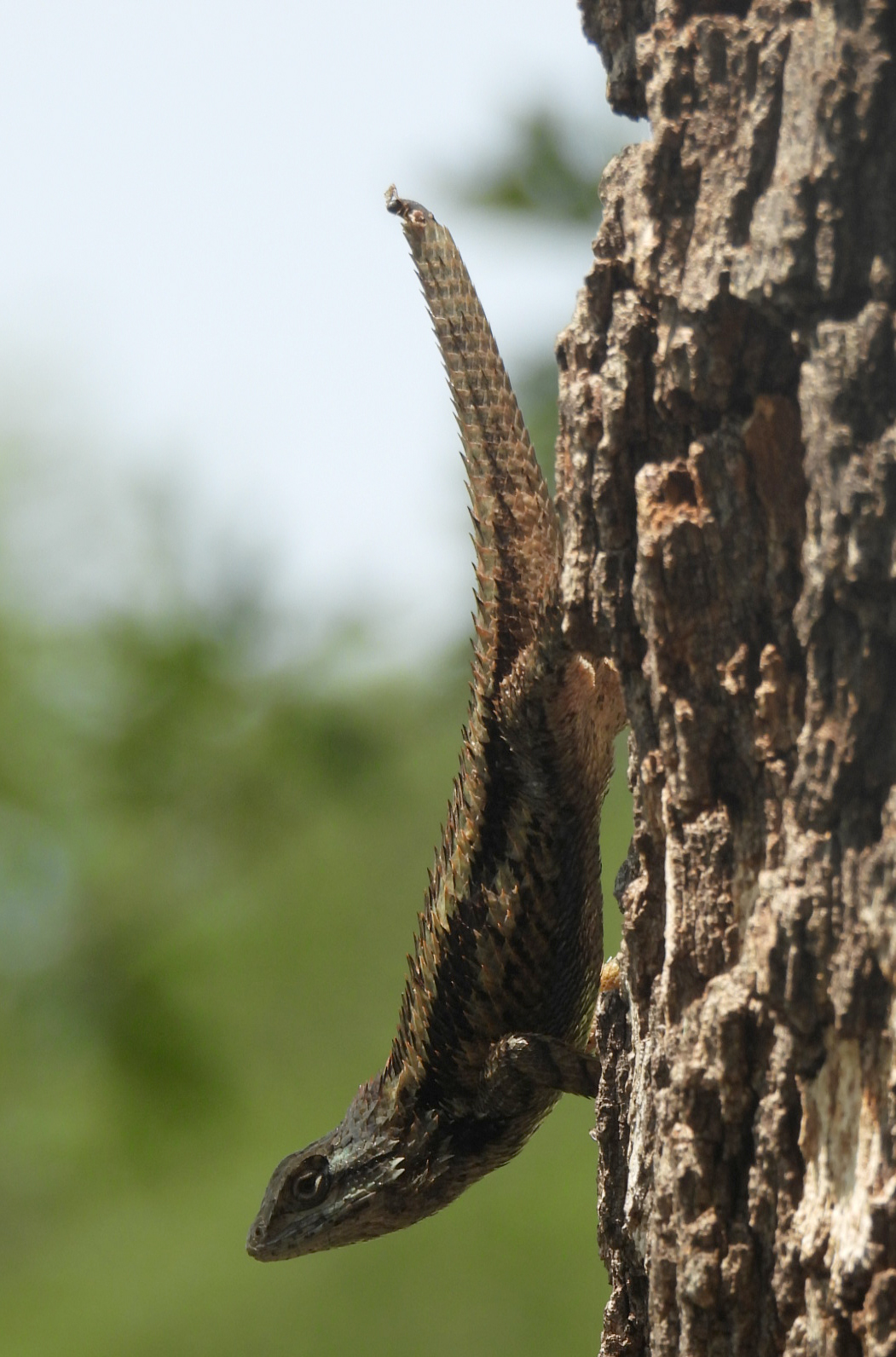
A Texas spiny lizard
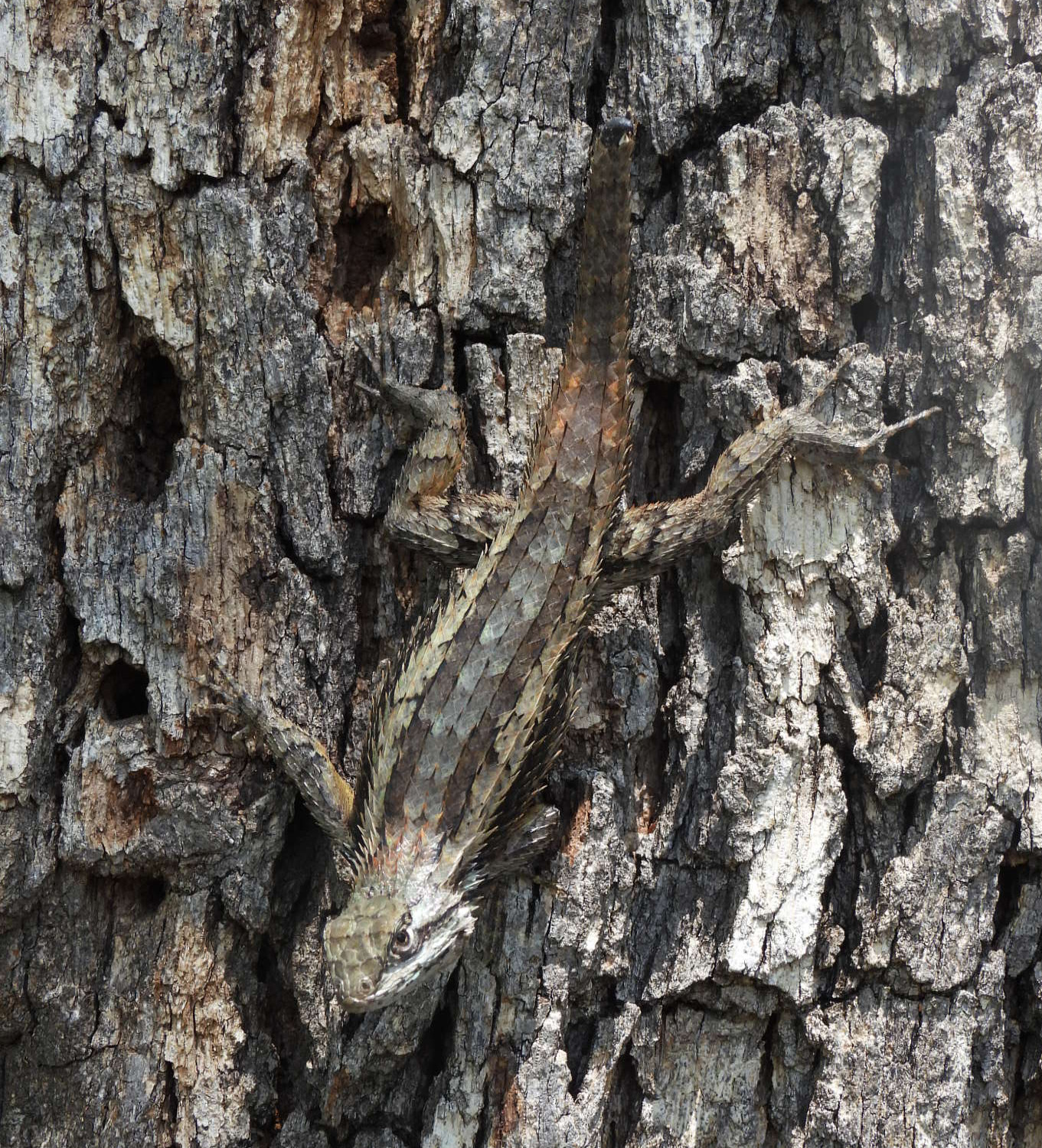
Beautiful color variations.
Looking for more information on this lizard, I picked up a book I had recently purchased but not yet read, Herping Texas: The Quest for Reptiles and Amphibians, by Michael Smith and Clint King. It turns out that this is not a species guide, but an enjoyable armchair travel book about decades-worth of trips through Texas to find herpetofauna (reptiles and amphibians) in their natural habitats.
The book is divided into chapters reflecting the 10 major ecoregions of Texas. In each chapter, the authors share a few favorite locations, describing the geology, plants, and other wildlife as well as some of the memorable adventures they had while searching for herps to photograph. Although I have never gone out specifically looking for herps, as I read the book, I was struck by how many of these species I have seen myself through the years, so I will share my sightings by region, starting with the Edwards Plateau of central Texas.
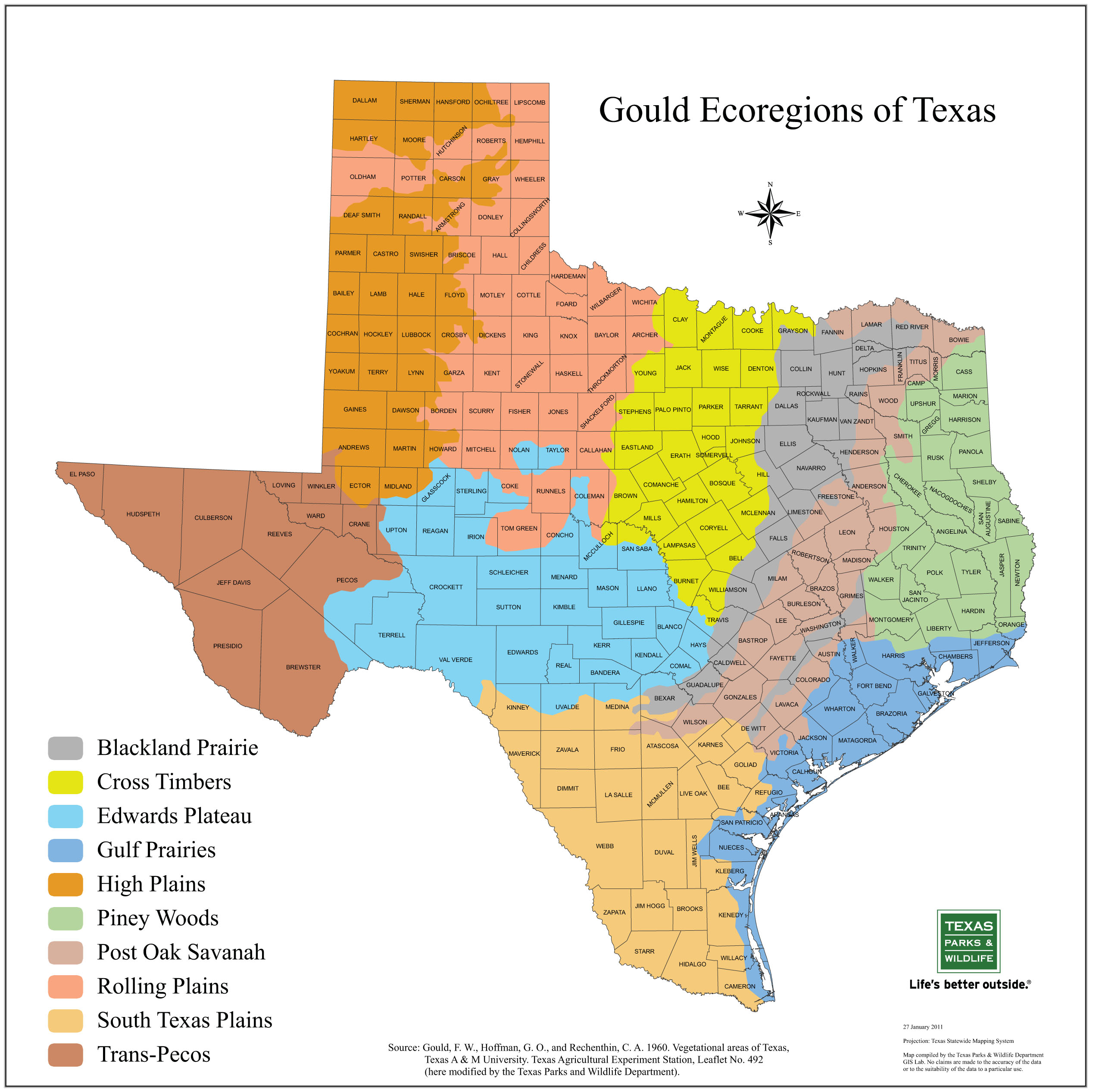
Gould Ecoregions of Texas
The pale blue section in the center of the map above shows the Edwards Plateau, reaching basically from the Colorado River in the east, to the Pecos River in the west. Eons ago it was a seabed, where limestone built up. As it was uplifted to an elevation of about 2000 feet, rivers started carving through the limestone, and erosion caused hills and canyons. It is called the Hill Country and for many of us, it is a beloved area of Texas.
Clint King wrote of one of his trips in this area, to Colorado Bend State Park, in the eastern part of the Plateau. Let me share a sample of the wonderful writing :
I had never seen such a congregation of buckeyes, painted ladies, red admirals, and sleepy orange sulphurs. They flitted everywhere, bursting out of the wake of our invasive hiking boots, erupting from blossoms of paintbrushes in brief clouds of abstract, vibrant color. Mockingbirds began to tune up with the emerging warmth, playing a diverse medley of the local birdsong in an erratic, fast-paced chain. To our left the river whispered, its banks masked by a virtual field of six-foot-high ragweed, their flowering tops pungent in the humid air… We hiked a mile or so down the Spicewood Springs Trail to the springs, where clear groundwater bubbled up to the surface to flow over white rocks and collect in transparent ponds tainted green with algae. Just beneath the surface, the algae waved in thick strands that seemed to float hypnotically like the hair of some witch confined to a water grave of unspeakable beauty. (p. 104)
I really love the way they set the scene before even describing the different reptiles and amphibians they encounter.
So the Texas spiny lizard I saw recently was also in the eastern part of the Plateau. Most of my own experiences are from the more central part, where our family owned a small property for about 20 years. Even though it was rocky and arid, I did not see reptiles very often. Small lizards would appear on the deck, but they were usually too quick for me to get any pictures. On a few occasions, I saw larger lizards on trees, and once a small Baird’s ratsnake (Pantherophis bairdi) was in the house! And on one of my last trips to that property, I saw a gorgeous black-necked garter snake (Thamnophis cyrtopsis) out in the open creek bed. (You can click on the images to see larger versions.)


The most unusual snake encounter was caught by our game camera. A coachwhip (Mastocophis flagellum) paid recurring visits to the water trough we had available for wildlife. The snake came eight times over six weeks in 2021, and I never saw it before or since!


And in publicly-accessible areas, I have seen common spotted whiptails (Aspidoscelis gularis) a few times, at Blue Hole in Wimberley, South Llano River State Park near Junction, and a rest stop in Gillespie County.


Next we will move on to the Gulf Prairies and the South Texas Plains!



Fascinating stuff. I was disappointed with the wildlife I saw when I first visited the USA in the 1970s. But really, I was too inexperienced (even now I am mostly self-taught) to understand how and where to look. If only there had been an internet back then . . . . .
I know what you mean! I bet even Yellowstone didn’t have a lot of wildlife in the open back then. The best place I have experiences is British Columbia in Canada — we did a road trip from Texas to Alaska in 2004, and BC had more wildlife along the roadside than we saw anywhere else. And also, for me digital photography and digital zoom changed everything; I am much more likely to get a good capture now.
Great post, Gwen. Good to see you back.
Thanks, Egidio! I hope to post more regularly!